
Standing Room Only in Charlotte

What the 2026 NFDA Convention revealed about Augmented Intelligence and the human work of funeral service
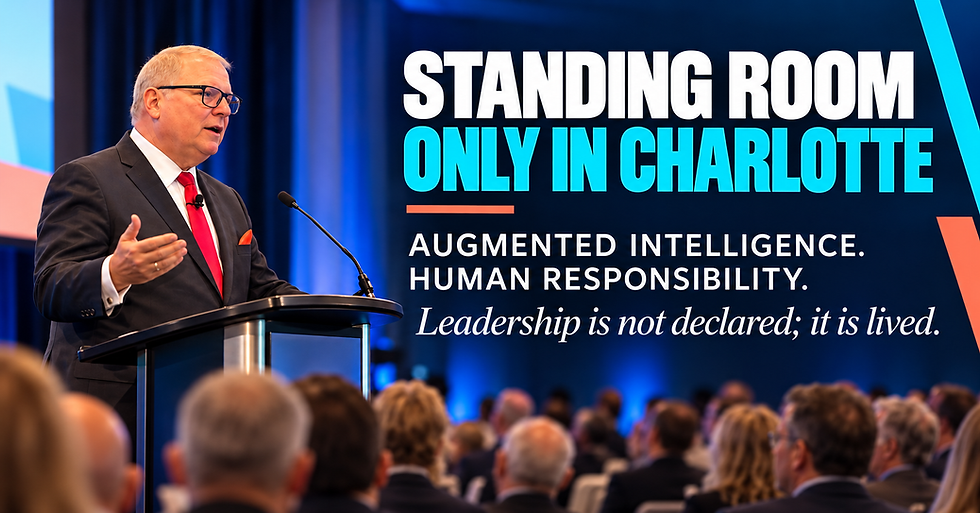
By the time the session began in Charlotte, the room was standing room only. That was gratifying. What stayed with me, however, was not simply that every chair was filled. It was the attention in the room. Funeral professionals came ready to think, ask thoughtful questions, and consider how a fast-moving technology might serve work that remains intensely human.
I had the privilege of presenting Harnessing AI in Funeral Service Communication at the 2026 NFDA International Convention and Expo. We talked about prompts, privacy, training, and practical uses for Augmented Intelligence. Yet the session did not begin with technology. It began with a family, a promise, and a difficult moment at 7:12 on a Friday evening.
The family arriving at 730
A family had been told that their father would be ready for a private viewing at 7:30. At 7:12, the evening funeral director discovered that he was not ready. Eighteen minutes remained before the family would arrive.
When they came through the door, the director said, “The prep room never told me there was a 7:30 viewing, so we’re going to need more time.”
At one level, this was a handoff failure. At another, it was a failure of communication at the precise moment a family needed steadiness. The explanation protected the employee by shifting responsibility somewhere else. The family heard something different. They heard that nobody was in charge.
Augmented Intelligence could not step into that room and repair the moment. It could not see the daughter’s face, recognize when an explanation had become too much, or offer a sincere apology. Those responsibilities belonged to the funeral director.
But the tool could have helped earlier. It could have helped the director practice taking ownership. It could have helped a manager turn a general value such as compassion into observable behavior. It could have created a realistic coaching scenario before the stakes involved an actual grieving family.
That distinction became the center of the morning. The opportunity is not to replace the funeral director. It is to prepare the funeral director more fully for the human work only a person can do.
The difference is the briefing
Many people first encounter AI as a writing tool. They ask it to draft an obituary, prepare an email, or create a social media post. Those uses can save time, but they barely begin to show what a language-based tool can do.
It can organize a procedure into a checklist. It can compare documents, identify repeated themes, and point out wording that could be misunderstood. It can turn a training manual into scenario-based questions. It can role-play a difficult conversation so that a manager or new funeral director can rehearse before the moment is real.
The quality of that work depends on what we give it. A weak prompt from the session asked, “Help me coach a funeral director who handled an upset family poorly.” The answer sounded reasonable, but it was generic. The model did not know what happened, what the funeral home expected, or what kind of coaching the manager wanted.
A stronger prompt supplied the known facts, the funeral home’s service standards, the desired outcome, and a boundary against inventing details. The response could then connect the employee’s words to the organization’s expectations, suggest questions that encouraged reflection, and create a short role-play for practice.
The technology had not changed. The briefing had.
Values need verbs
The same lesson applies to workplace culture. A funeral home may say it values compassion, accountability, or excellence. Those words matter, but an employee cannot consistently perform a noun. Neither can an AI model.
We make a value teachable when we describe what it looks like in motion. Compassion means slowing down when grief makes information difficult. It means explaining choices without pressure. It means making room when a family asks the same question twice. Accountability means acknowledging the impact of a mistake before explaining how it happened.
When we define those behaviors for Augmented Intelligence, we also clarify them for our staff. In that sense, teaching the model can expose an important leadership question: Have we made our expectations clear enough for people to follow?
That is one reason I prefer the term Augmented Intelligence. Used well, the tool extends human capability. It can help us prepare, practice, organize, and examine our thinking. It does not possess our professional judgment, our conscience, or our responsibility.
Practice before the stakes are real
This may be one of the most useful opportunities for funeral service. We would never expect a football team to learn the fundamentals for the first time during the game. Yet a young funeral professional may encounter a difficult family dynamic for the first time while sitting across from a family in grief.
Augmented Intelligence can give us another practice field. A trainee can rehearse an arrangement conference with a family that is quiet, divided, confused, or unsure what it wants. A manager can prepare for a difficult employee conversation by separating known facts from assumptions. An existing procedure can become a checklist, a short lesson, and a realistic scenario that reveals whether the learner understands the reason behind the work.
It can also help preserve institutional knowledge. Every funeral home has someone people seek out when an unusual situation arises. That person remembers the exception, the lesson behind a procedure, and the question nobody else thinks to ask. Before that employee retires, leaders can capture those lessons in an appropriate way and use AI to organize them into training material. The goal is not to create a digital copy of the employee. It is to honor and preserve what a career has taught.
The guardrails remain human
The thoughtful questions in Charlotte made clear that funeral professionals are not only interested in what these tools can do. They are asking what responsible use requires.
The five rules I shared were straightforward. Protect private information. Verify important facts. Keep the human decision with a responsible person. Do not confuse efficiency with care. Own the output.
If my name is on an obituary, an employee communication, or a policy, I remain responsible for it. “I used AI” is not an explanation a family should ever have to accept for an error, an insensitive message, or a promise that cannot be kept.
Efficiency only matters if we are thoughtful about what we do with the time it returns. If a tool saves fifteen minutes on an email, the best outcome is not simply a faster email. The opportunity is to use some of those minutes to be more present with an employee, a colleague, or the family sitting across the table.
The conversation continued
After the presentation, the conversation moved to NFDA Central during a book signing for Lead by Legendary Example. I am grateful to everyone who stopped, picked up a copy, shared an experience, or asked one more question.
The presentation and the book may appear to address different subjects, but they meet at the same place. Technology does not create culture. Daily behavior does. A mission statement does not make a leader. The choices made under pressure reveal leadership.
That is why the success of the session will not be measured only by a full room. It will be measured by what happens after people return home. Does a manager define one value more clearly? Does a new funeral director receive a chance to practice before a difficult conversation? Does a team improve one handoff? Does a leader use time saved by technology to give more attention to a person who needs it?
My challenge at the close of the session was intentionally modest: teach the model one useful thing about your funeral home, then use it for one real need. One standard. One conversation. One training task. One piece of work made better.
Thank you to NFDA for the opportunity to present, and thank you to the funeral professionals who filled the room with curiosity, discernment, and a clear commitment to the families they serve.
Leadership is not declared; it is lived.


Comments