
The Changing Face of Funeral Service

The Changing Face of Funeral Service
A Profession Sustained by Commitment and Strained by Its Systems

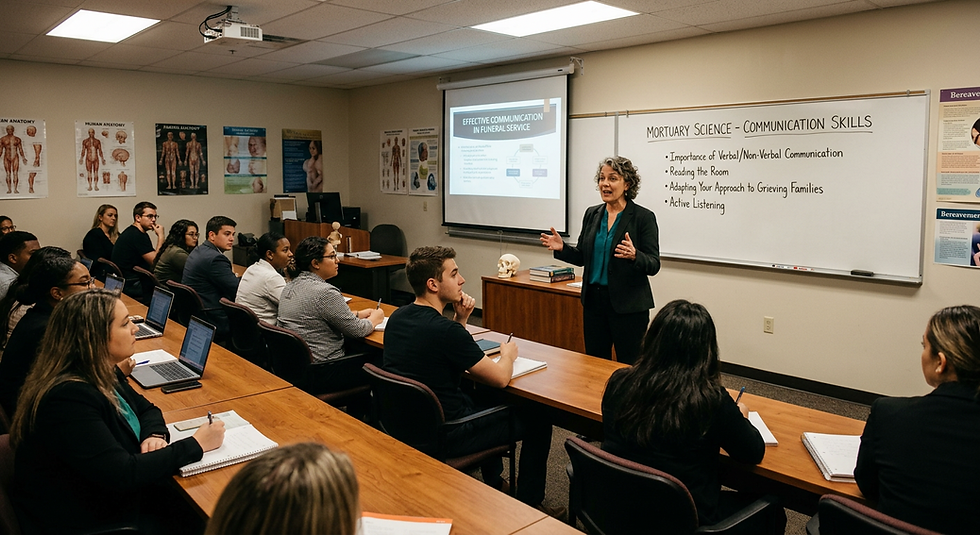
When I entered mortuary school in the early 1980s, fewer than 10 percent of the students in my class were women.
You did not need a statistical report to understand who the profession expected to become a funeral director. You could see it by looking around the classroom.
Funeral service was overwhelmingly male and frequently generational. Sons followed fathers into family-owned funeral homes. Leadership was often inherited, and the pathway to ownership frequently depended upon the family into which someone had been born.
Women were present, but they were clearly in the minority.
More than four decades later, the classroom looks remarkably different.
According to the American Board of Funeral Service Education, 68 percent of today’s funeral-service graduates are women. In 2024, 7,193 students were enrolled in accredited programs. Fewer than 15 percent of graduates reported being related to someone already working in funeral service.
Women have moved from representing fewer than one in 10 students in my classroom to more than two out of every three graduates entering the profession today.
They are not entering funeral service at the margins.
They are the profession’s primary educational pipeline.
Federal employment data show that the transformation has moved beyond the classroom.
Women accounted for approximately half of the employees working in funeral homes and funeral services in 2025.
The face of funeral service has changed.
The more difficult question is whether the profession has changed with it.
A New Workforce Inside an Older System
Women now serve as funeral directors, embalmers, arrangers, crematory operators, educators, managers, executives and owners. Their growing presence has strengthened the profession, expanded its talent pool and introduced new perspectives into how funeral homes lead employees and serve families.
Demographic change, however, does not automatically produce organizational change.
Many funeral homes continue operating within structures developed when the assumed funeral director was male, often supported by a spouse who managed family, household or administrative responsibilities. Long and irregular hours were accepted as part of the profession. Constant availability was treated as evidence of dedication. Advancement often depended upon ownership, family relationships or informal networks.
The workforce has changed faster than some of those expectations.
Many women are entering funeral service without a family connection, inherited business or established network. They may be carrying demanding professional responsibilities while also managing family, caregiving and community obligations.
They are entering a profession that needs them.
The question is whether the profession is prepared to support them.
Commitment Is Masking Depletion
The 2026 Funeral Women Lead Pulse Survey offers an important view into that question.
The survey collected responses from 555 women across funeral and deathcare. Participants represented a relatively balanced range of career stages, from women in their first five years to leaders with more than 16 years of experience.
The survey’s most important finding is the tension between commitment and depletion.
Seventy-five percent of respondents said they were likely or very likely to remain in the field for at least another 12 months.
At the same time, 73 percent reported feeling emotionally depleted at least sometimes.
If we look only at retention, we might conclude that the workforce is stable.
If we ask how the workforce is actually doing, we receive a very different answer.
People can stay and still be struggling. They can remain committed while becoming depleted. They can continue serving families while quietly questioning how long they can sustain the pace.
Retention alone is not proof of organizational health.
Women may remain because they love the work, care about their coworkers, feel responsible for the families they serve or have invested years in their professional identities.
Their presence should not be interpreted as evidence that everything is working.
Funeral Service Does Not Have a Passion Problem
The findings suggest that funeral service may be facing less of an immediate retention crisis than a sustainability crisis.
Women are not necessarily leaving because they have lost their sense of calling. Many are staying because that calling remains strong.
The problem is that commitment can become something an organization quietly consumes.
The dependable director receives another family because management knows she will handle it.
The capable arranger absorbs another responsibility because she has always found a way.
The experienced employee answers another after-hours call because there is no one else available.
The promising manager receives a stretch assignment but not the authority, compensation or support required to succeed.
Eventually, reliability becomes a burden placed upon the people least likely to refuse it.
That is not resilience.
It is depletion disguised as dedication.
The survey identifies compensation, staffing and scheduling as leading contributors to burnout. Better pay and additional staffing were identified as more meaningful improvements than schedule changes alone.
That matters because organizations often respond to burnout with wellness language.
Employees are encouraged to practice self-care, establish boundaries or become more resilient.
Those practices may help, but they cannot correct chronic understaffing or inadequate compensation.
You cannot meditate your way out of a staffing shortage.
You cannot solve a compensation problem with an employee-appreciation lunch.
You cannot ask employees to establish boundaries while operating a system that depends upon them having none.
Burnout is not only a wellness issue.
It is a staffing issue, a compensation issue and a leadership issue.
The Mid-Career Fault Line
The survey identifies women with six to 15 years of experience as particularly vulnerable.
These women are no longer new to funeral service. They have demonstrated competence and are trusted with difficult cases, larger workloads and greater responsibility. They may be training employees, supervising departments or informally holding teams together.
They are experienced enough to carry significant responsibility but may not be senior enough to control the systems creating the pressure.
Emotional depletion and stretch assignments peak during this mid-career period.
These are precisely the people funeral homes can least afford to lose. They are the future managers, owners, educators, mentors and executives. They possess the operational knowledge and experience needed to guide the next generation.
Organizations must examine whether they are truly developing mid-career women or simply giving them more work.
A stretch assignment should include authority, resources, guidance and recognition. Without those elements, it is not leadership development.
It is workload expansion.
Mentorship Is Not Sponsorship
The survey also reveals a significant development gap.
Eighty percent of respondents reported that they do not have a mentor. Nearly half said they would like a sponsor, but only 13 percent reported having an actual sponsor or advocate.
The distinction matters.
A mentor offers advice.
A sponsor creates opportunity.
A mentor may encourage a woman to pursue a leadership position. A sponsor speaks her name when that position is being discussed.
A mentor helps someone prepare for an important meeting. A sponsor makes certain she is invited into the room.
This becomes especially important when fewer than 15 percent of current graduates have a family connection to funeral service. Many women are entering without the professional networks traditionally available to the sons and daughters of funeral-home owners.
They may possess the education, ability and commitment to lead while lacking access to the relationships through which opportunities have historically been created.
Good work does not automatically become visible. Being capable does not guarantee that someone will be recognized as a leader.
Executives should be evaluated not only by the people they recruit, but also by the people they develop.
An organization that constantly looks outside for talent may eventually forget how to build talent from within.
Representation Is Not Influence
The profession should celebrate the fact that women now represent most funeral-service graduates.
But representation in the classroom is only the beginning.
The next questions are more difficult:
Are women remaining in funeral service?
Are they compensated fairly?
Are they advancing into ownership and executive leadership?
Do they receive authority equal to their responsibilities?
Do they have a meaningful voice in decisions?
The Funeral Women Lead survey reports that one in five women already holding director or executive titles still want leadership development. Respondents also described concerns involving respect, advancement, professional voice and management support.
A title does not always produce influence.
A promotion does not automatically provide preparation.
A seat at the table does not mean someone’s voice will be heard.
The pipeline into funeral service has changed dramatically. The pipeline into ownership and senior influence must change with it.
Families Are Changing Too
The workforce transformation is occurring alongside a significant change in consumer preferences.
NFDA projected the national cremation rate to reach 63.4 percent in 2025, more than twice the projected burial rate. Nearly 36 percent of NFDA member firms reported offering online cremation arrangements, with another 25 percent planning to do so within four years.
At the same time, NFDA members identified the availability of qualified personnel as their greatest anticipated business challenge.
These trends are connected.
Families increasingly want arrangements that are flexible, personalized, affordable and accessible. They may begin online, select cremation or reject portions of the traditional funeral format.
That does not mean they no longer need funeral professionals.
A simple cremation does not mean a family has no need to gather, remember, receive support or say goodbye. In many cases, families need more guidance because the familiar structure has been removed.
The profession must become more technologically capable without becoming less human. It must offer convenience without reducing funeral service to a transaction. It must respond to changing preferences while protecting dignity, trust and meaning.
Women are entering funeral service during this transition, not after it.
They are helping shape what the profession will become.
Supporting their success is not merely a women’s issue.
It is an industry issue.
The Face Has Changed. Leadership Must Follow.
The state of funeral service today is not one of collapse.
It is one of transition.
The profession has people who care deeply about the work. It has women prepared to lead. It has communities that still need guidance when death occurs.
Passion alone, however, will not carry funeral service forward.
Owners and executives must examine compensation, staffing, after-hours expectations and workload distribution. Mentorship should be structured. Sponsorship should be expected from senior leaders. Promotion criteria should be transparent. Leadership development should continue after someone receives a management title.
Organizations must also measure more than turnover. They should examine depletion, engagement, psychological safety, internal promotions and whether their most dependable employees are carrying an unreasonable share of the organization.
Do not wait for a resignation letter to tell you something is wrong.
By then, the decision may have been forming for years.
When I think back to my mortuary-school classroom in the early 1980s, I remember a profession in which women represented less than 10 percent of my class.
Today, women represent 68 percent of funeral-service graduates.
That is more than a demographic change.
It is a transformation of the profession itself.
The women entering funeral service today bring talent, education, commitment and a willingness to serve families during some of life’s most difficult moments.
They should not have to inherit every outdated expectation along with the profession’s responsibilities.
Inadequate compensation is not tradition.
Chronic understaffing is not a calling.
A lack of mentorship is not a rite of passage.
Excluding talented women from influence is not an unavoidable feature of funeral service.
The women who responded to the Funeral Women Lead survey are not saying they no longer care about the profession.
They are saying they want the profession to care more responsibly for the people carrying it forward.
The face of funeral service has changed.
Its leadership systems, workplace expectations and pathways to influence must now change with it.
Funeral service does not have a passion problem.
It has a systems problem.
And systems can be changed.
Sources
Funeral Women Lead. The State of Women in Funeral and Deathcare: 2026 Pulse Survey Report. Findings based on responses from 555 women collected from January through June 2026.
American Board of Funeral Service Education. Directory of Accredited Programs and Funeral Service Education Statistics.
National Funeral Directors Association. 2025 Cremation and Burial Report.
U.S. Bureau of Labor Statistics. Funeral Service Workers, Occupational Outlook Handbook.
U.S. Bureau of Labor Statistics. Employment of Women on Nonfarm Payrolls by Industry Sector, 2025.


Comments